WORK PROGRAM/PRACOVNÝ PROGRAM
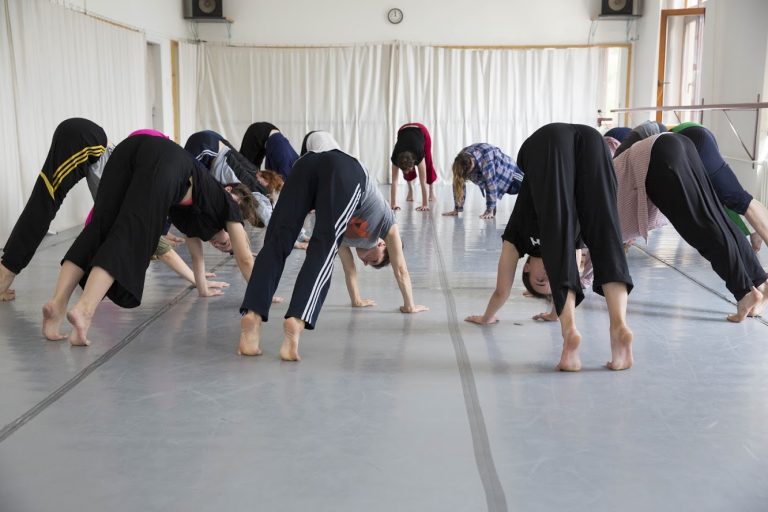
Besides the performances, we also organise masterclasses and workshops for all participants which will point out different approaches and possibilities of dance creation as well as how to teach dance techniques.
10. June / 10. jún
10.00 – 12.00
workshop 1 – Contemporary – Tamás Bakó (HU)
workshop 2 – Body Management for Dancers „What the body does remember“- Johannes Randolf (AT)
14.30 – 16.30
workshop 3 – Shaping Bodily Expression – Yuri Korec (SK)
workshop 4 – Attention in Motion: Instant Composition – Mirka Eliášová (CZ)
Lecture – Contemporary dance and new technologies Risima Risimkin (MK)
11. June / 11. jún
10.00 – 12.00
workshop 5 – Contact Improvisation – Giedré Kirkilé (LT)
workshop 6 – Choreographic Workshop – Adrijana Danchevska Rovchanin (MK)
14.30 – 17.00
CONTEXTUALIZE, SHARE, DISCUSS – Maja Hriešik (SK) and all participants
12. June / 12. jún
10.00 – 12.00
workshop 7 – Fluid Attention in Dance – Lukáš Bobalik (SK)
workshop 8 – The Subtle Body/Brain – Esther Balfe (AT)
14.30 – 17.00
CONTEXTUALIZE, SHARE, DISCUSS – Maja Hriešik (SK) and all participants
13. June / 13. jún
10.00 – 12.00
CONTEXTUALIZE, SHARE, DISCUSS – Maja Hriešik (SK) and all participants
10 6. 2026
10.00 – 12.00 WORKSHOP 1 402
Tamás Bakó
Budapest Circus Arts and Contemporary Dance College (HU)
Contemporary
The class draws on eclectic materials and approaches, shifting between task-oriented explorations and set sequences as a framework for practice. It invites an exploration of the body’s architecture and potentialities by tracing and inhabiting natural movement pathways, and by cultivating a deeper awareness of its anatomical, kinetic, and sensory resources.
It approaches the body as a somatically informed, alignment-oriented, and interdependent system, shaped through skeletal organization and articulated joint relationships. Movement develops through organic pathways within the body and it is understood as directionality, volume, and spatial composition, shaped by physical forces, multidirectional organization, and the temporalities of breath, tonal modulation, elongation, suspension, fall, and momentum.
Tamás Bakó
Tamás Bakó finished his dance education at the Budapest Dance School in 1995. He has been a member of international and Hungarian ensembles led by Ismael Ivo, Marco Santi, Adrienn Hód, Gábor Goda, and others. He has participated in numerous independent projects as a dancer or co-creator. Since 2009, he has been teaching contemporary dance and Contact
Improvisation at the Budapest Contemporary Dance Academy. From 2022, he has been coordinating the BA course in contemporary dance at the Budapest Circus Art and Contemporary Dance College. He has also taught as a guest teacher at other dance institutions and festivals such as SEAD (Salzburg) and La Manufacture HES-SO (Lausanne), Kontakt Budapest: International Improvisation Festival.
10.00 – 12.00 WORKSHOP 2 218
Johannes Randolf
Anton Bruckner Privatuniversität Linz (AT)
Body Management for Dancers „What the body does remember“
As a dancer and dance artist your body is your instrument which you have to take very well care and fine tune every day. During the dance education as well as during professional experiences everybody´s body collects smaller or bigger injuries, disbalances, compensations. In order to be able to have a long lasting and healthy career you need to give you body the chance to recover from exhaust training and get rid of those disbalances and compensations. That does not mean to simply not move but to use the wisdom and logic of the body and is physiology. In this workshop Johannes presents connections within the body that help understanding how it works and how to prevent yourselves from injuries and how to recover more quickly from injuries.
Here are some of the topics he will cover in this workshop:
- The cause for the pain is not where the pain is located
- A weak muscle is not an untrained muscle
- How to strengthen a muscle within seconds without conventional training
- How to balance your pelvis-spine area in order to have a strong core stability
- He will demonstrate some tests and give solutions for individual physical problems for dancers.
Johannes Randolf
received his dance education at the Dance Academy in Rotterdam and is a certified trainer and pre-trainer for the Gyrotonic Expansion System® as well as a Master Trainer for Gyrokinesis® an osteopath and physiotherapist. He danced with various companies and choreographers, including in Europe and Canada. He teaches contemporary dance at the IDA – Institute for Dance Arts at the Anton Bruckner University in Linz, was artistic co-director of the postgraduate dance company x.IDA for six years, and artistic co-director of choreographic centre Linz for five years. Johannes Randolf teaches numerous workshops at various festivals and training centres both nationally and internationally. Among others, he is a guest lecturer at the Dance Academy in Rotterdam and the University of Calgary. His own injury as a young dancer led him to physiotherapy study as well as osteopathy and many other therapeutic concepts always in the search for better help, regeneration for dancers. He leads workshops for „Body Management 4 Dancers“ in different universities, dance educations and professional companies and treats the students at IDA as well as many professional dancers in his practice in Linz/Austria.
14.30 – 16.30 WORKSHOP 3 402
Mgr. art. Yuri Korec, ArtD.
Department of Dance, Academy of Performing Arts in Bratislava (SK)
Shaping Bodily Expression
Sensory perception systems are fundamental for the body’s orientation in space and the organization of its movement. Over time, the body develops functional movement patterns. These become the basis for bodily expression, which is recognizable even in a social and cultural context. During the lesson, we will focus on creative concepts that provide frameworks for deconstructing established movement patterns and open up the potential for shaping bodily expressivity for choreographic creation.
Juraj Korec
Choreographer, therapist, and dance educator Juraj Korec currently works as an assistant professor at the Department of Dance Creation at the Academy of Performing Arts (VŠMU) in Bratislava. In 2018, he successfully defended his dissertation on the topic „The Body in the Context of Dance Performance,“ which laid the foundation for his academic activities in the study specialization of Dance Theater and Performance. He teaches classes in contemporary dance focused on movement research, instant composition, and the performativity of the body. He has also been engaged in his choreographic work for a long time, which he produces and presents under the artistic platform Yuri Korec & Co. His artistic portfolio includes several successful full-length works with a recognizable signature style as well as three internationally awarded dance films. He was involved in the founding of the Platform for Contemporary Dance – Plast, an organization bringing together creators and associations from the field of contemporary dance in Slovakia. Juraj also works as a therapist of the somatic system Rolfing® and is the first Certified Advanced Rolfer® in Slovakia. He incorporates experiences and knowledge from his therapeutic and somatic practice into his choreographic work.
14.30 – 16.30 WORKSHOP 4 218
Mgr. Mirka Eliášová, Ph.D.
Department of Dance, Academy of Performing Arts in Prague (CZ)
Attention in Motion: Instant Composition
During the workshop, we will focus on clear work with the body, composition, and attention—the attention of the performer, the audience, and the choreographer all within a single body. This will lead to the creation of improvised group compositions and to exploring how to perceive them. In my work, I draw on the experiences and insights I gained during our three-year research project “Improvisation as a Choreographic, Authorial, and Creative Principle,” in which, together with researchers Mish Rais and Lizzy Le Quesne, I encountered various approaches to the discipline of instant composition among internationally recognized legends of this form.
Mirka Eliášová
Mirka Eliášová is a Czech choreographer, dance teacher and performer. She is a graduate of the Master’s and Doctoral Programme of Choreography at the Department of Dance at the Academy of Performing Arts, where she currently teaches. She also teaches children and non-professional dancers of all ages and organises educational and popularisation workshops. Since 2008, she has collaborated with the Berg Orchestra on site-specific performances featuring live music by contemporary composers. She creates interactive performances for children as well as experimental performances for adult audiences; she is the founder of the Eli a kol. ensemble and the recipient of several awards (e.g., the Prix de Intellect, ČTP Award 2000). She has long focused on the use of improvisation principles in contemporary dance and instant composition.
14.30 – 16.30 LECTURE 220
Prof. Risima Risimkin, PhD. (MK)
University Goce Delcev, North Macedonia – Dance Department
Contemporary dance and new technologies
The lecture is based on research on the connection between contemporary dance and new technologies, in terms of new creative directions in the performing arts. Contemporary dance and the development of the performing arts are linked to the development of technology since the beginning of the 20th century. For the first time, at the beginning of the 20th century, choreographer and dancer Loi Fuller, through a special approach, performed choreography using new innovative aspects and the use of light, creating light effects that create a special magic on stage. From that moment on, technology becomes part of the performing arts, with new expression breaking through the extreme boundaries of stage performances and going beyond that space.
Computer-generated choreography as a term was first encountered in the 1960s in the USA. From the very beginning, it represents a synergy of the work of choreographers and computer engineers, whose focus is on creating dance through artificial intelligence (AI). Initially, the idea was based on the possibility of building a tool that would help choreographers in the geometric setting of ensemble dances, in order to avoid wasting time on setting up in the studio. In the past 80 years, technology has advanced and there are currently several tools that deal with the construction of dance sequences. The research focuses on the creative collaboration between the body and the algorithm, which is currently taking place on multiple levels, in order to detect new possibilities for artistic expression and performance in the digital age.
From a philosophical perspective, the questions we ask are: where does the connection between dance art and new technologies lead us? Is there a possibility of replacing living artists in the future and what are the advantages of creating artificial intelligence tools for creating dance sequences? What are the disadvantages? Through interactive presentation, this paper will attempt to provide answers that will demonstrate the justification of this connection between art and AI, considering that it is a trend in which we live and art cannot be separated from the social and societal developments around us.
Prof. Risima Risimkin, PhD.
Prof. Risima Risimkin, PhD is a Macedonian choreographer, with international renown, who this year celebrates 45 years of artistic creation. Risimkin has been awarded the Order of the Knight of Arts and Letters of France, she is the winner of the European Person of the Year award for 2024 and is the winner of the „Gorgi Makedonski“ award – Award for avant-garde representative in contemporary dance education and creativity in 2025. Risimkin’s choreographic work is making enormous progress on the domestic dance scene. Risimkin has performed on stages in Europe, Asija, Africa & USA. Risimkin is the founder of a university program for contemporary dance education, which is within the Film Academy at the Goce Delcev University, Stip, N. Macedonia, where she was a dean of it for two consecutive terms. Risimkin was a member of the Board of Directors of CID UNESCO – International Dance Council, for two consecutive terms from 2005 to 2013. She is the founder and artistic director of the international festival Dance Fest Skopje from 2005 to 2024, which this year was held for the 22st time, the founder and artistic director of the Skopje Dance Theater in 2001, the only contemporary dance company in the country, which has been a great success on the international dance scene around the world and represents Macedonia in the highest artistic circles of the world. She is the author of over fifty original choreographies, with which she has transformed the domestic dance scene; she is considered the initiator of the creation of the contemporary dance scene (Emilija Dzipunova, The Macedonian Ballet Scene. (p.254) Skopje: Panili 2011).
11. 6. 2026
10.00 – 12.00 WORKSHOP 5 402
Giedré Kirkilé
Lithuanian Academy of Music and Theatre / Dance and Movement Department (LT)
Contact Improvisation
Contact improvisation plays with the artistry of falling off balance, counterbalance, finding the shelves of the body, learning the mechanics of the body in order to handle someone else’s weight or be lifted, breathing techniques, and can involve the art of getting to know your partner past the physical point through the physicality.
„I got acquainted with contact improvisation about 20 years ago in workshops with Benno Voorham and Eszter Gal. Later we experimented a lot and searched for material for performances based on CI, organized the first CI jams in Vilnius. Through movement and various forms of improvisation, I am still looking for unique ways of movement, colours, layers and depths, connection with myself and others.
In this workshop we will explore how to find flow and common balance, attentiveness and courage, caution and playfulness together with one or several partners. How many new possibilities can I find when I am not dancing alone?
Giedré Kirkilé
Giedrė Kirkilė is a dance performer, creator, and teacher. For more than twenty years, she has danced with Vytis Jankauskas Dance Theatre and was twice nominated for the Golden Stage Cross Award for her roles in the theatre’s performances. In 2022, the Contemporary Dance Association honoured Giedrė with their award for the most memorable dance roles of 2021.
Since 2014, Giedrė has been teaching improvisation and contemporary dance technique to dancers and actors at the Lithuanian Academy of Music and Theatre, actively participating in shaping the dance studies curriculum. In 2023, she received the highest award from the Ministry of Culture – the honorary ‘Carry Your Light and Believe’ badge – for her contribution to fostering Lithuania’s contemporary dance scene. Since 2025 she took a position of Head of Dance and Movement Department
10.00 – 12.00 WORKSHOP 6 218
Adrijana Danchevska Rovchanin
University Goce Delcev, North Macedonia – Dance Department (MK)
Choreographic Workshop
Intensive choreographic workshop focused on rhythm as the driving force of movement creation, inspired by te energy and atmosphere of rave culture. Participants will explore musicality, timing, repetition, and dynamic movement patterns through improvisation and composition tasks, developing original material and a strong connection between sound, space, and collective energy.
Adrijana Danchevska Rovchanin
Adrijana Danchevska Rovchanin is a choreographer, dancer and Dean of Film Academy at the “Goce Delchev” University in Shtip. One of the first emerging choreographers shaped through the Skopje Dance Theater and she has played a significant role in the development of contemporary dance in North Macedonia and beyond. Internationally, Danchevska has worked as a choreographer at CODARTS University in the Netherlands with dancers from the Rotterdam Dance Academy, and at the University of the Art- ZHdK in Zurich, Switzerland. She also choreographed and directed Home (the film), the first Macedonian dance film. Danchevska received both the First Prize for Best Choreography and the Audience Award at the 26th Festival of Choreographic Miniatures in Belgrade, Serbia.
Her choreographies have been presented at renowned festivals, including Contemporary Dance Week (Zagreb, Croatia), Laiks Dejot (Riga, Latvia), Silk Road Festival (China), SHARE Festival (Bratislava, Slovakia), and Holland Dance Festival (The Hague, Netherlands). As a performer, she has appeared at Battery Dance Festival (New York), Meet in Beijing (China), Tanec Praha (Czech Republic) with Yukio Suzuki, ITS Festival (Amsterdam), Tanzmesse (Cologne), Ankara Solo Dance Festival, and others. In 2023, she choreographed Interweaving, the second segment of Prayers of My Body, a production at the National Opera and Ballet honoring poet Aco Šopov. Danchevska is also a co-founder of Tanc Bunker and the contemporary dance festival Tanc Bunker – Platform 01, both of which support and promote contemporary dance practices. Her recent work Mockumentary is selected in top 10 at Moving Balkans 2026 show-case.
14.30 – 17.00 CONTEXTUALIZE, SHARE, DISCUSS
Maja Hriešik (SK) and all participants
Contextualize, share, discuss is aimed at developing the students‘ abilities to talk about their artistic ideas, choices they make and the ways of working. These sessions facilitate by Maja Hriešik offer attentive moments of listening and sharing, of peer-to-peer dialogue. Their aim is also to provide participants with the context in which the works presented at the festival were created, to formulate observations from the performances seen, and to identify the creative tools and intentions used, with the active participation of students and teachers from all participating schools.
12. 6. 2026
10.00 – 12.00 WORKSHOP 7 402
Mgr. art. Lukáš Bobalik
Department of Dance, Academy of Performing Arts in Bratislava (SK)
Fluid Attention in Dance
Workshop of contemporary dance technique focused on developing kinesthetic and sensory awareness through work with breath, imagination, and touch. Together, we will explore how to maintain a vivid connection with oneself and the surrounding environment while in motion. The aim is to deepen bodily sensitivity as a foundation for resilience in dance.
Lukáš Bobalik
Lukáš Bobalik is an independent movement artist creating both authorial work and collaborative projects in Slovakia and the Czech Republic. He is a graduate of the Eva Jaczová Conservatory and the Academy of Performing Arts (VŠMU) in Bratislava, where he is currently pursuing his doctoral studies. His research focuses on the psychophysical readiness of dancers, with particular emphasis on the sustainability of a dance career within the independent contemporary dance scene. Bobalik is characterized by an experimental approach that merges functional movement and dance, as well as by integrating dance with creative processes from other artistic disciplines. He is the founder of the T-O-K platform, which aims to develop and promote contemporary dance in Slovakia and to highlight the specific needs and aspects of professional dancers’ work.
10.00 – 12.00 WORKSHOP 8 218
Esther Balfe
Musik und Kunst Privatuniversität der Stadt Wien (AT)
The Subtle Body/Brain
A preliminary warmup which combines encompasses organic folding of the limbs and kinetic form, including a strength building practice embedded within yoga. We will concentrate the next part of the workshop to assimilating and studying a structure gleaned from Forsythe repertoire from which to orientate the movement, acquiring tools and skills to apply to the last part of an improvisational dance practice.
Esther Balfe
Esther Balfe has built her life around dance and performance in Europe and internationally. Esther has worked with Choreographers Philip Landsdale, Liz King, Jai Gonzales, Catherine Guerin, Michael Keegan-Dolan and worked for a decade with William Forsythe, firstly as a guest artist for Ballet Frankfurt and later with his touring company as a full-time member with the ‘The Forsythe Company’. During this time Esther was immersed in the experimental and collaborative creative process with TFC, touring and performing Forsythe’s later works, internationally up until 2016. Her multifaceted career spans an interdisciplinary arch, across Ballet, Contemporary dance, explorative and performative applications from Physical Theatre to experimental A.I based Artistic works. Her extensive international collaborative experience includes, working with artists such as Allison Brown, Klaus Maria Brandauer, Benoîr Lachambre, Nigel Charnock, John Gerrard, Ivar Hagendoorn, Christoph Winkler, Noé Soulier, Wolfgang Tschapeller and Christina Jauernik, Sabine Glenz, Willi Dorner, and more recently with Alex Gottfarb and Anna Novak. Esther has Choreographed for the Schauspielhaus Wien, Nikolaus Habjan at Theater an der Wien and Semperoper in Dresden including setting Keegan-Dolans work at the Bolshoi, Moscow in 2021. Esther currently holds a position as Professor and mentors’ young dance students in the program for classical and contemporary Dance at Musik und Kunst Universität, in Vienna.
14.30 – 17.00 CONTEXTUALIZE, SHARE, DISCUSS
Maja Hriešik (SK) and all participants
Contextualize, share, discuss is aimed at developing the students‘ abilities to talk about their artistic ideas, choices they make and the ways of working. These sessions facilitate by Maja Hriešik offer attentive moments of listening and sharing, of peer-to-peer dialogue. Their aim is also to provide participants with the context in which the works presented at the festival were created, to formulate observations from the performances seen, and to identify the creative tools and intentions used, with the active participation of students and teachers from all participating schools.
13. 6. 2026
10.00 – 12.00 CONTEXTUALIZE, SHARE, DISCUSS
Maja Hriešik (SK) and all participants
Contextualize, share, discuss is aimed at developing the students‘ abilities to talk about their artistic ideas, choices they make and the ways of working. These sessions facilitate by Maja Hriešik offer attentive moments of listening and sharing, of peer-to-peer dialogue. Their aim is also to provide participants with the context in which the works presented at the festival were created, to formulate observations from the performances seen, and to identify the creative tools and intentions used, with the active participation of students and teachers from all participating schools.